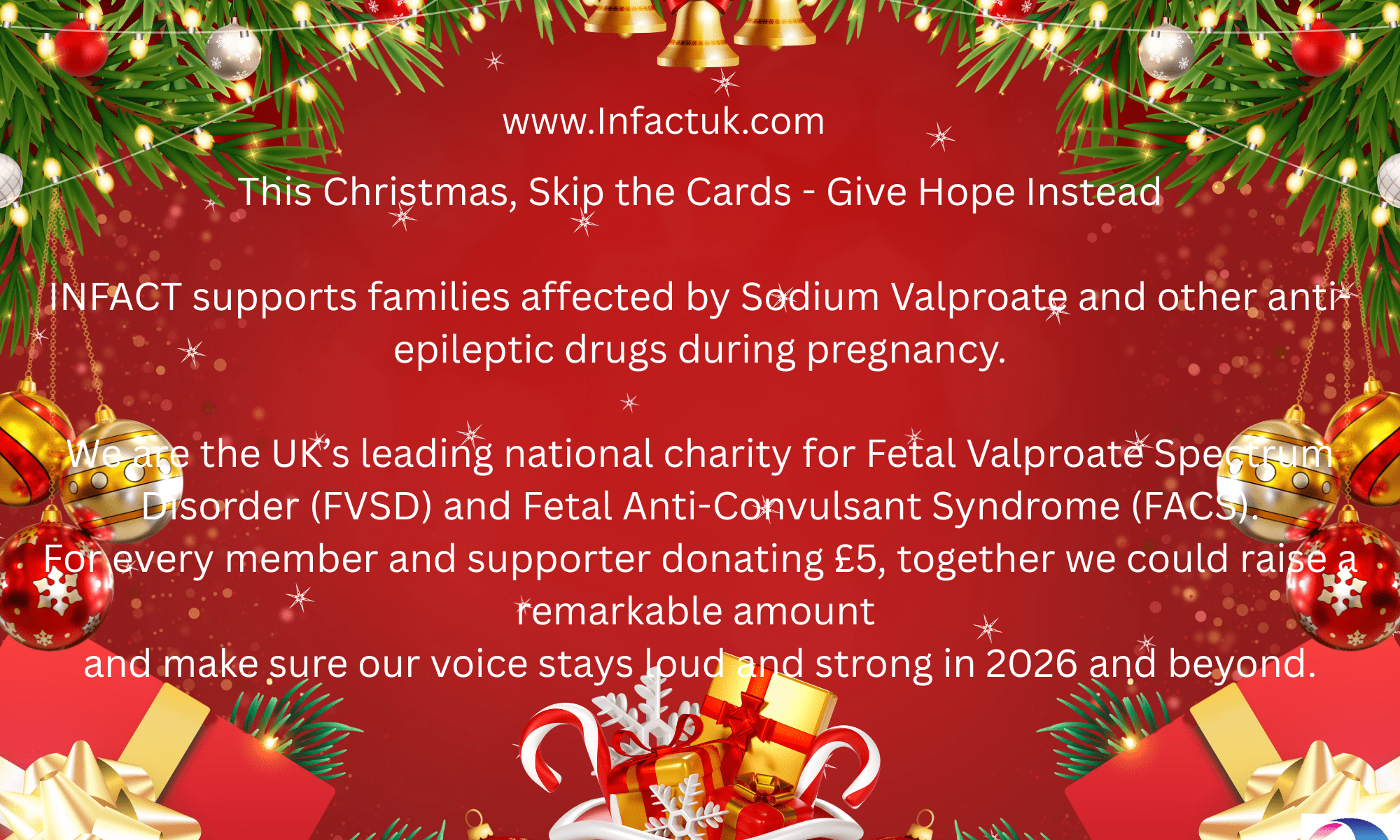
More and more people are choosing not to send Christmas cards, and instead donate what they would have spent to causes close to their hearts.
This year, if you’re thinking about doing the same, We’d love for you to consider supporting INFACT.
INFACT exists to support families whose lives have been changed forever by exposure to Sodium Valproate and other anti-epileptic drugs during pregnancy. We are the UK’s leading national charity for Fetal Valproate Spectrum Disorder (FVSD) and Fetal Anti-Convulsant Syndrome (FACS) – a lifelong disability that affects thousands of children and their families.
We do this because no family should face this alone – yet with no government and pharmaceutical funding and a non profit organisation, every penny we receive matters.
Your donation helps us to: • Provide free educational resources, practical support, and guidance for parents, carers, and professionals. • Run vital awareness and national campaigns to keep FVSD and FACS on the political agenda. • Lobby government, regulators, and MPs to push for justice, recognition, and better protections for affected families. • Cover essential costs that keep our helpline, website, resources, and community going strong.
If each member and supporter donated just £5, together we could raise a remarkable amount – and make sure our voice stays loud and strong in 2026 and beyond.
This Christmas, let’s turn the love we share into real support and real change for families who need it most.
We know how painful and unfair it feels to watch families in France receive compensation for the harm caused by Valproate (Epilim), while families here in the UK continue to be denied justice. The difference isn’t the harm, because the harm is the same devastating harm in both countries and around the world.
The difference lies in the legal systems and political decisions made in each nation.
Key Legal Differences: Funding & Responsibility
France
What happened:
Families successfully brought a class action against Sanofi (the manufacturer) and the French medicines regulator(ANSM).
Outcome:
The courts found both Sanofi and the State responsible for failing to warn women.
As a result, in 2017 the French Parliament created a National No-Fault Compensation Fund (ONIAM).
United Kingdom
What happened:
Legal Aid for the UK class action (known as the FAC Litigation) was withdrawn in 2012, shutting down the only legal route that could have forced Sanofi to compensate families.
Outcome:
Without Legal Aid, families were left with no viable way to pursue litigation against the manufacturer. Bottom line:
France won its case in court.
The UK case was stopped, not because of weak evidence, but because Legal Aid was pulled.
The UK’s Only Remaining Route, Parliament:
Because the legal case against Sanofi was shut down, the only path left is to hold the UK Government to account for its failures.
This is known as the Parliamentary Route, the strategy INFACT is currently pursuing, on firm legal advice.
Why Litigation Is No Longer Possible in the UK?
To avoid confusion:
No new legal action can be taken against Sanofi in the UK.
Even families who were not part of the original litigation cannot start a new claim because:
The UK spent £3.2 million in public funds preparing the class action
When Legal Aid was withdrawn, the case collapsed.
Financially, it is impossible to privately fund a lawsuit of this size.
Legally, the precedent and procedural history block future claims.
Why was Legal Aid really withdrawn?
The Legal Services Commission withdrew Legal Aid from the case as it was deemed by them that the case was not sufficiently likely to succeed in court against the manufacturer, Sanofi. The decision to withdraw legal aid was appealed by the claimants, but the appeal was rejected by an independent panel of lawyers.
Documents uncovered later by INFACT indicate that the evidence gathered would likely have shown:
Sanofi warned the UK Government about serious risks, even though Sanofi failed to issue stronger public warnings in the 1980s.
The Government then chose deliberately not to warn women, despite knowing the risks.
This dual responsibility, manufacturer and State, may have been politically explosive, and withdrawing public funding halted the case before those findings could reach court. This is why the Parliamentary Route is now the only viable pathway to compensation.
Moral vs Legal Responsibility:
It’s important for families to understand a key distinction: Morally, Sanofi is responsible.
It is their medicine, and they failed for decades to provide adequate, timely, and prominent warnings about the risks to unborn babies. Families across the UK, France, and globally were harmed because the manufacturer did not act with the urgency or transparency that was needed.
Legally, however, responsibility in the UK sits with the MHRA and the wider Establishment.
The British regulatory system, the MHRA, Government departments, advisory committees, and health authorities, were the ones who chose what information was shared with women. They received warnings, yet suppressed them.
Because of this, the legal system views the failure as one of State regulation, not manufacturer liability.
This is why the UK cannot pursue Sanofi through the courts, and why the Government must now provide redress.
INFACT’s Breakthrough at the National Archives:
Our investigation at the National Archives was the turning point.
We discovered documents proving that,
as early as 1973, the UK’s Committee on Safety of Medicines knew Valproate carried a high risk of birth defects.
The Government made a deliberate decision to caution doctors but not women taking the medicine.
This evidence which we directly presented to Jeremy Hunt in person when he was Health Minister contributed to the creation of the Independent Medicines and Medical Devices Safety (IMMDS) Review.
A Fight Against the Establishment:
Our campaign sits alongside some of the UK’s hardest-fought justice movements:
The Post Office scandal
Hillsborough
Contaminated Blood
WASPI
These campaigns all share something in common:
They challenge deep systemic failings within the State itself.
This work is slow, exhausting, and often met with resistance, but it can be won through persistence, unity, and truth.
Our Blueprint for Success:
The Cumberlege Review (2020)
The Independent Medicines and Medical Devices Safety Review (IMMDS), chaired by Baroness Julia Cumberlege, found that thousands of families harmed by Valproate experienced avoidable harm caused by systemic failures.
Key outcomes:
Confirmed decades of failure by regulators, the NHS, and Government.
Highlighted that women were repeatedly dismissed, ignored, or misinformed.
Recommended the creation of an independent Redress Agency and a Government-funded compensation scheme.
The Government offered a “fulsome apology” but rejected the recommendation to introduce compensation.
What Happened Next: INFACT at the Health Select Committee (December 13th, 2022)
Following the Government’s refusal to implement the Cumberlege Review’s recommendation for a compensation agency, INFACT were called to give evidence at the Health and Social Care Select Committee.
On 13th December 2022, we presented the full scale of the Valproate scandal, exposing the decades of Government failures, regulatory neglect, and the human cost carried by families.
Our evidence, delivered directly to MPs, made it impossible for the failings to be ignored any longer. This moment was critical. It was our testimony that pushed the Government to acknowledge the unresolved injustice and ultimately led to the commissioning of the next major report: The Hughes Review.
The Hughes Report (2024) commissioned in the wake of INFACT’s Select Committee evidence, was tasked specifically with examining compensation options for families harmed by Valproate.
Key outcomes:
Recognises the lifelong, devastating harm endured by affected families.
Affirms the urgent need for a Government compensation scheme.
Proposes a realistic, two-stage redress model that could be implemented without delay.
Why Your Voice Matters
In France, families won justice through the courts.
In the UK, our route to justice is through Parliament, and that means your voice is essential.
Every message you send, every story you share, every email to your MP builds the pressure that forces Westminster to act. MP support is absolutely critical. Without MPs raising this in Parliament, the Government can continue to delay, minimise, or ignore the issue.
We need families to keep writing to MPs, meeting with them, sharing your experiences, and asking them to stand with the campaign. The more MPs who speak up, the harder it becomes for the Government to deny the urgent need for compensation and care.
Your voice drives awareness.
Your MPs carry that voice into the heart of Westminster.
Together, we create the pressure needed for change
The Parliamentary Route remains the only legally viable path to justice, with a united community and committed MPs behind us, we will get there.
With the Cumberlege Review and the Hughes Report behind us, along with support from MPs and Peers and the continued support from The Sunday Times and media outlets the evidence is now overwhelming. The Government can no longer deny what happened, or delay addressing it.
Today , World Patient Safety Day, we must confront a harsh truth: systemic failures in medicine are not past history. They are ongoing. And when safety fails, it is innocent lives, pregnant women, children, families, who bear the lasting, often irreversible cost.
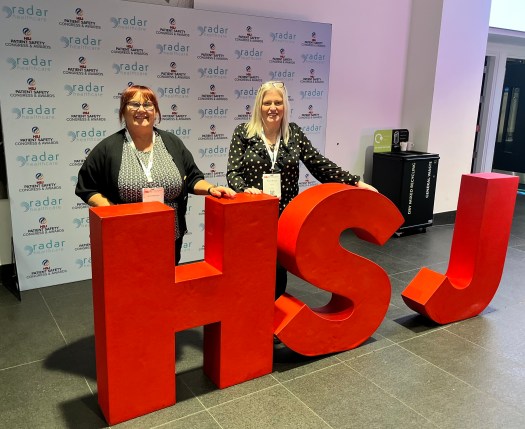
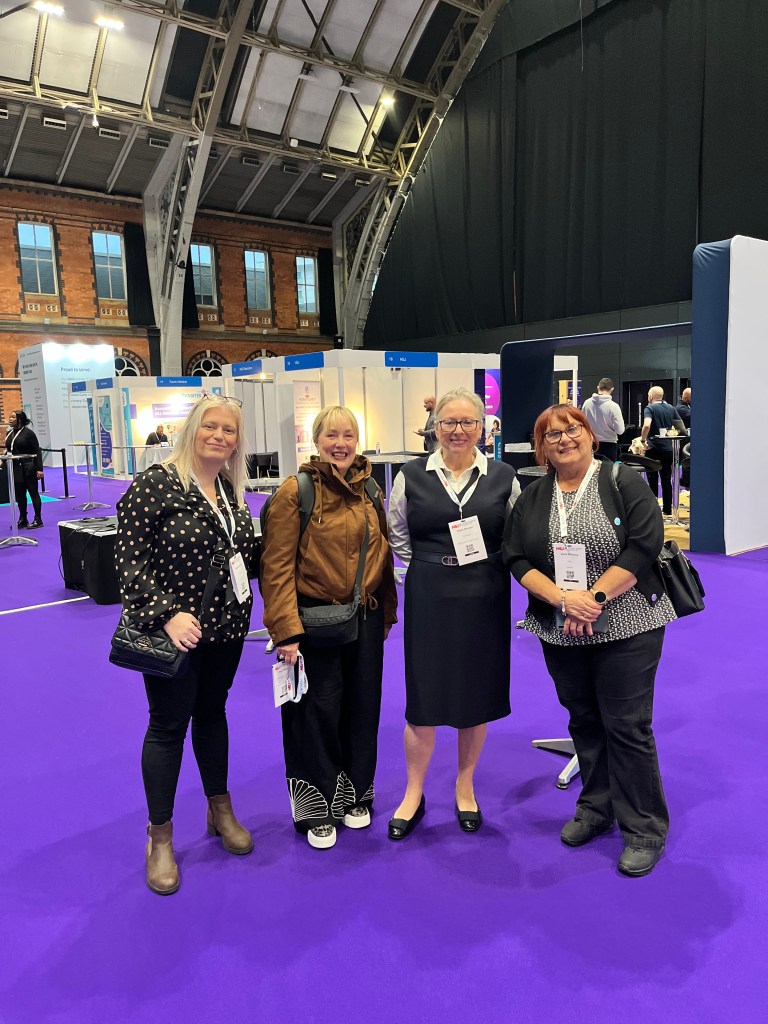
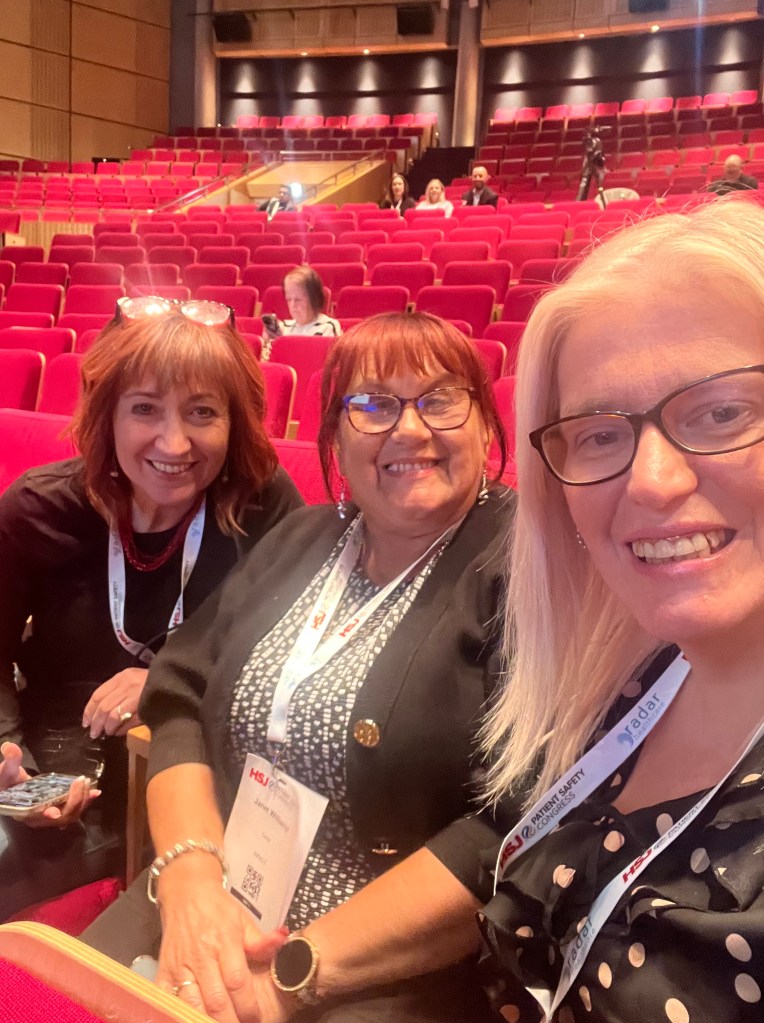
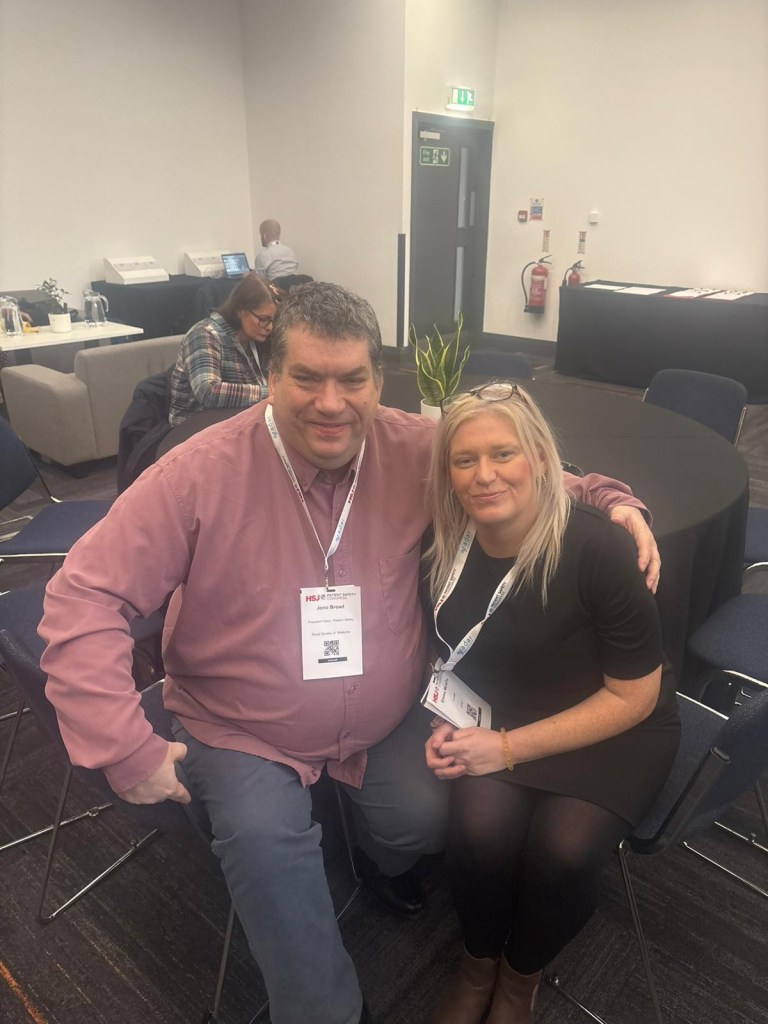
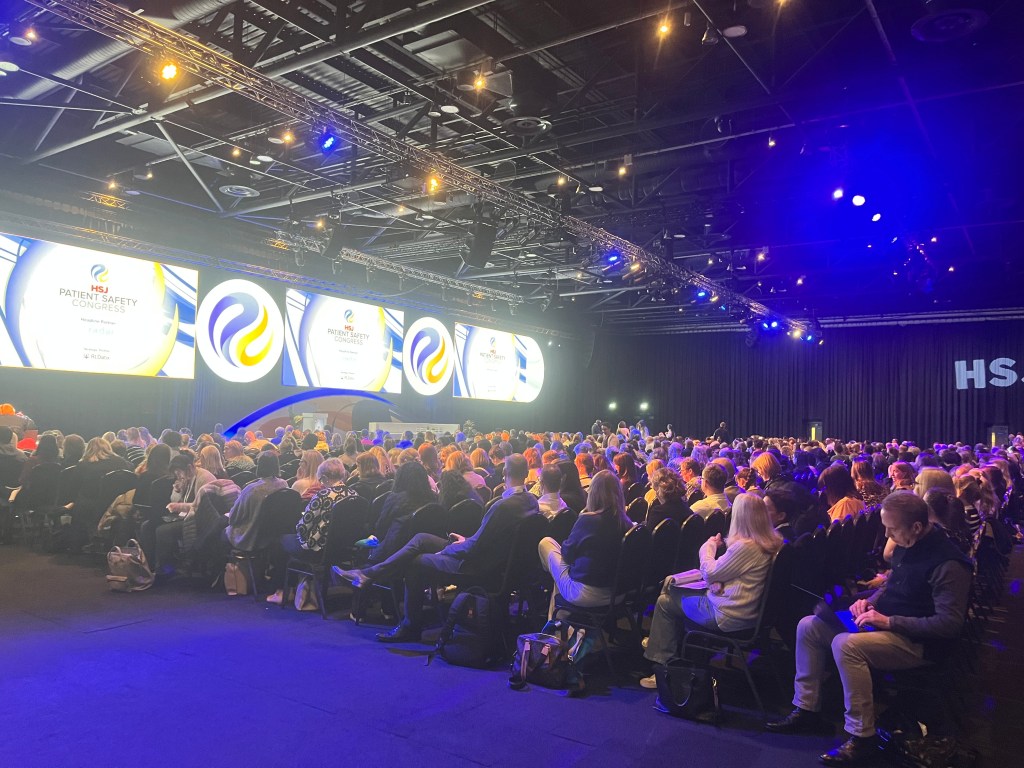
Over the past two days we have been honoured to attend the Health Service Journal’s Patient Safety Congress , the UK’s leading Patient Safety Forum. HSJ get it absolutely right. They bring together policymakers and professionals, but crucially they also give voice to those who have been harmed, bereaved, those using grief and trauma to demand change. The most amazing people who through tragedy, never wanted or expected to be in this realm of campaigning, but like us here , want real change and safety, because it matters and saves lives. HSJ provide a platform for ideas rooted in lived experience. Wouldn’t it be something if these very people , those with the deepest insight into what goes wrong – were in charge of designing safety systems, instead of civil servants who too often treat safety as a checklist rather than a moral imperative?
As the leading voices and recognised Valproate Campaign, Emma was invited to speak on a panel at the Conference titled “What Happens When Safety Fails?” and chaired by Sunday Times Health Editor Shaun Lintern. She was joined on the panel by Kath Sanson (Sling the Mesh Campaign) Dr Sonia McCloud (Oxford University), Charlotte Harpin(Browne Jacobson) and Dr Shruthi Narayan (NHS Blood and Transfusion) We reflected on the Valproate scandal, mesh, and the routes of clinical negligence etc.
The Ongoing Price of Harm
We hear time and again that “we must learn the lessons”. As campaigners it is something we hate hearing and often roll our eyes at. Reviews, inquiries, committees, action plans are all put in place. But the harm continues. Because learning alone is not enough without accountability, investment, and system-wide willingness to change.
A striking example of the cost , both human and financial , of patient safety failing:
In 2024–25, the NHS paid £3.1 billion in clinical negligence compensation and legal costs (Clinical Services Journal).
The estimated annual cost of harm , the wider cost of incidents that should never happen , is £4.9 billion (Law Gazette).
Liabilities for future negligence claims now exceed £60 billion (Medscape).
These figures are not just numbers. They represent money diverted from safe staffing, from continuity of care, from services that protect women and babies.
Yet despite these astronomical figures, compensation for families affected by Valproate remains unresolved. Two Government-backed inquiries :
recommend proper compensation and interim payments for children harmed by Valproate. These children and adults face lifelong barriers: loss of earnings, lack of opportunities, complex care needs, inaccessible housing, health costs, and the emotional toll on parents who must often give up work to provide full-time care.
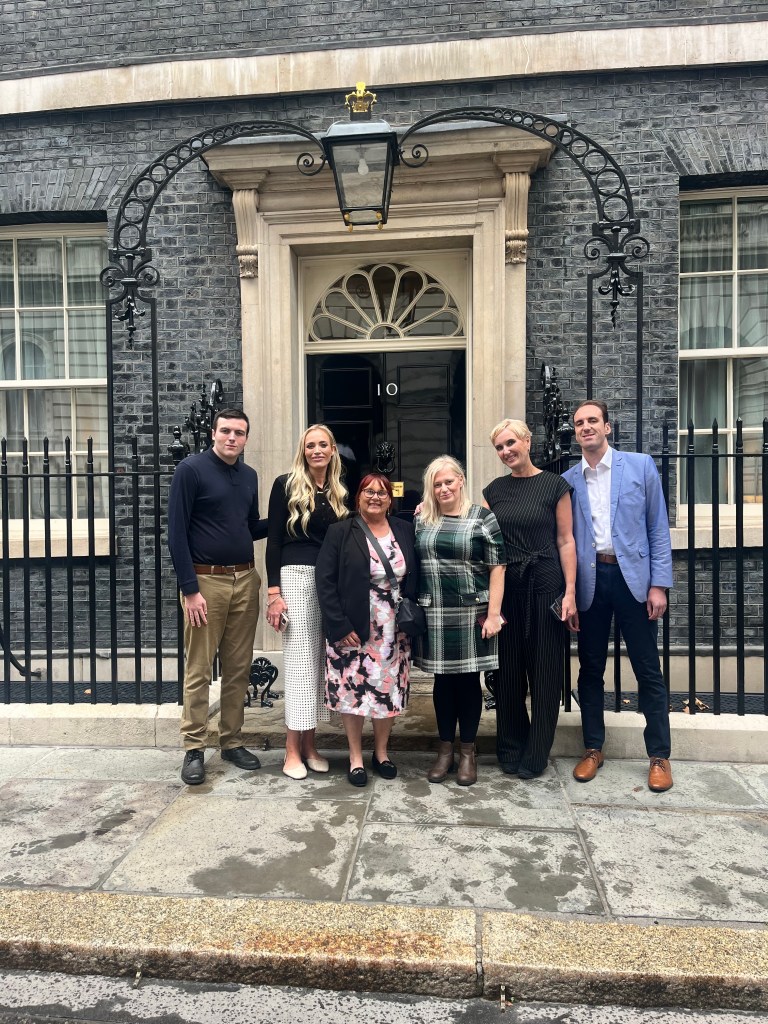
Bureaucracy stands in the way. Just last week, we travelled to No.10 Downing Street with two disabled adults harmed by Valproate to hand-deliver a letter to the Prime Minister to highlight that 5 years since The Cumberlege Review, and 18 months since the Hughes report published, we are still waiting. for the recommendations to be meaningfully answered. The standard Government response, “We are working at pace and will respond soon,” is simply not good enough. If patient safety truly mattered to those in power, they would act decisively instead of compounding trauma of already-harmed families.
Medical Misogyny: A Persistent Force
Across almost every major healthcare scandal reported in the media, a common thread emerges: medical misogyny – the systematic dismissal, minimisation, gaslighting or outright denial of women’s concerns. For decades, mothers who questioned the safety of medicines or raised alarms about unusual symptoms were told their worries were unfounded or reassured that “the benefits outweigh the risks.” Their lived experience was rarely treated as credible evidence.
The Valproate scandal is one of the clearest examples. Warnings about the dangers of Sodium Valproate in pregnancy were available for years, yet regulators and policymakers delayed action. Women were left unprotected because their voices were not considered data worthy of response. Only through relentless, patient-led campaigning, powered by mothers and carers fighting for their children ,did the system finally begin to acknowledge and address the harm.
This pattern extends far beyond Valproate. The devastating maternity scandals in Shrewsbury, Telford, Nottingham, and elsewhere tell similar stories: women reporting unbearable pain, worrying symptoms, or a gut instinct that something was wrong were too often ignored, patronised, or blamed. Their intuition, sometimes their very lives , was sacrificed to a culture that privileged hierarchy, convenience, or denial over listening and acting with urgency.
Until women’s experiences and expertise are treated as indispensable to evidence-based care, patient safety will remain compromised. True reform means embedding respect for women’s voices at every level of the healthcare system , from consultation rooms and wards to research, regulation, and government policy.
Tick-Boxes vs. True, Patient-Centred Care
So much of what is done in patient safety becomes about compliance: ticking boxes, filling forms, and protecting the system before the patient. System safety first and patient safety second. That needs to change, and for every patient, every mother, every child.
We must demand:
Proper funding for the NHS, so staff are not overstretched, so safety is not compromised because of understaffing.
Genuine listening to patients and families, listening to their concerns, not just consultation, but co-design of safety systems.
Transparency and accountability, when harm occurs, admitting failings, learning deeply, not superficially.
Government that treats harm seriously: not with inertia or excuses, but urgent, systemic correction.
Patient voice matters, systemic change comes from those with lived experience. Listen and act more
The Government Has to Step Up
For too long, the burden of blame is deflected onto front-line professionals: the midwives, the nurses, the obstetricians. Or worse, onto mothers. But the real people who need to be made accountable are the top executives of the Healthcare system, the regulators, and the people in charge of regulation (Government)
Ensure that regulation is proactive, not reactive.
Make those in power answer for harm that could have been avoided.
Move beyond symbolic action plans and tick-box culture to meaningful structural reform.
Duty of Candour and the Hillsborough Law: Truth as Prevention
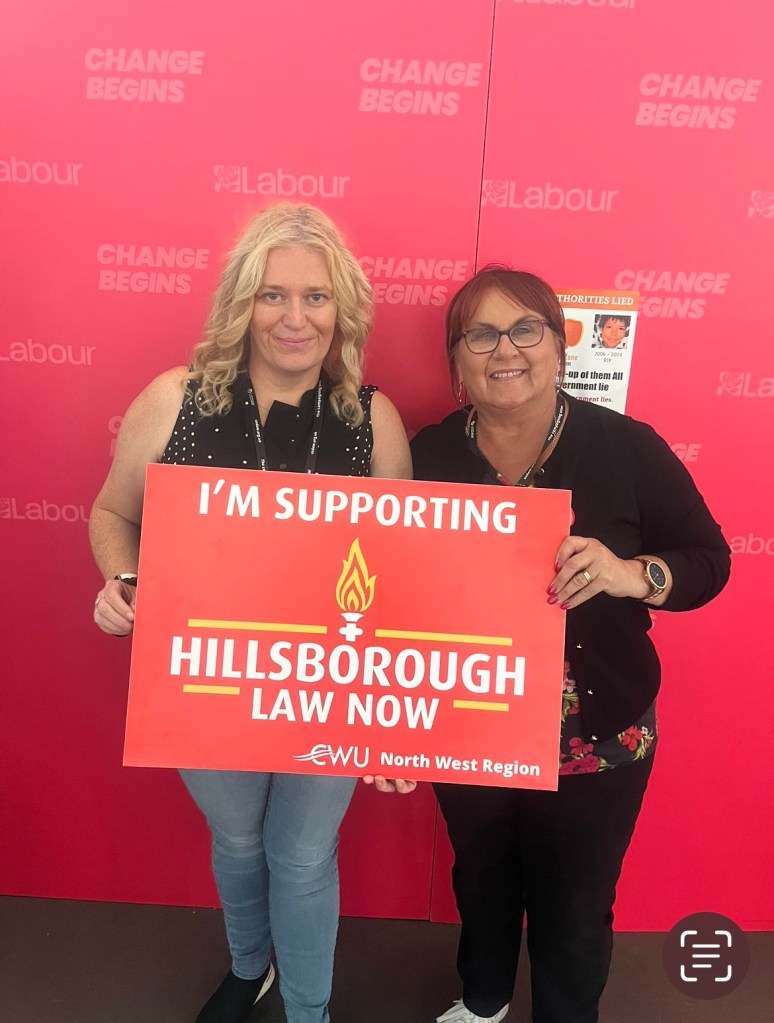
A vital step forward is enforcing a strong Duty of Candour – a legal and professional requirement for organisations and staff to be open and honest when something goes wrong. Whilst at Patient Safety Congress, the Prime Minister announced the long-awaited Hillsborough Law, which will underpin candour with a statutory duty of full disclosure in major public safety incidents. This is hugely welcome here at INFACT and fully support it.
History shows why this matters. In 1973, Government officials were aware of the teragenocity of Valproate yet still decided to grant a full liscense, yet evidence was hidden, and pregnant women were not told. The documents we here at INFACT found at the National Archives prove this case. That deliberate concealment continued until official warnings were finally released only eight years ago. The Valproate Scandal is not an accident of science; it is a man-made national scandal, born of secrecy and denial. Had candour been a legal obligation, backed by real consequences, thousands of children could have been protected, and parents spared decades of pain. Embedding a genuine culture of truth-telling, supported by the Hillsborough Law, is essential if we are to prevent medical scandals from ever happening again.
The Yellow Card Scheme: Missed Warnings, Missed Chances
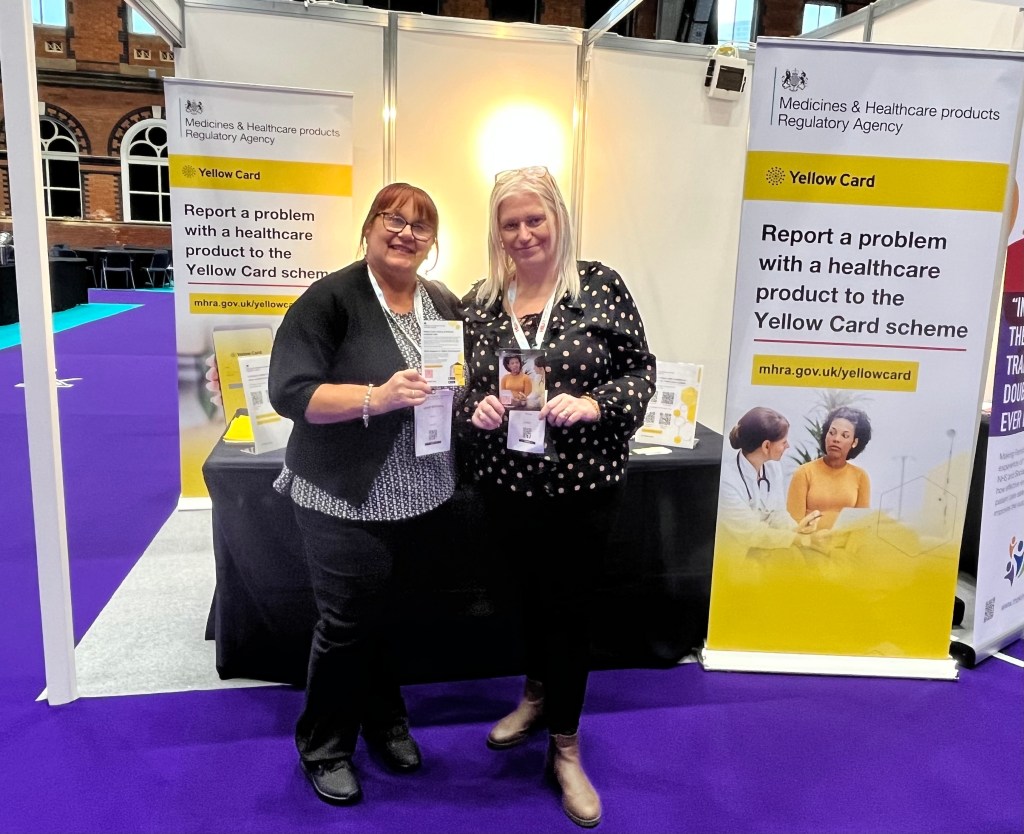
Another critical learning point discussed at the Congress and on Emma’s panel was the Yellow Card Scheme, the system for reporting suspected side effects of medicines to the MHRA. The Yellow card scheme was introduced in 1976 and still at present, reporting is voluntary for doctors, meaning we do not capture the full picture of medicine-related harm. For fourteen years we have called for Yellow Card reporting to be made mandatory, so that if a patient raises a concern with their GP, the doctor must report it.
In all that time there have been many scandals related to medicines and devicesThalidomide, Valproate, Contaminated Blood, DES Daughters, Mesh, Primodos (and these are the reported and acknowledged campaigns – there will be many more needing attention!)
Had concerns about Valproate and the other medical scandals been systematically logged and analysed through a robust, mandatory Yellow Card process, the dangers might have been identified far earlier. This pattern repeats elsewhere: at the start of our campaign, we urged that Valproate warnings must be compulsory. We were told by a senior MHRA official, “That will never happen.” Instead, the Valproate Toolkit was introduced as optional guidance , and, unsurprisingly, women were not consistently warned. Only when the Pregnancy Prevention Programme made those warnings mandatory did things begin to change.
This is a clear example of why patient safety cannot be left to discretion or goodwill. Mandatory systems save lives; optional systems leave people exposed. When agencies resist evidence-based calls for reform, they risk condemning thousands to avoidable harm.
Children Harmed: A Living Reminder
Children harmed by Valproate, by faulty maternity care, or by medicines in pregnancy are living embodiments of what happens when safety fails. They are not statistics. They are our responsibility. Their voices and their existence demand change.
On this World Patient Safety Day, let’s move past all the empty slogans and instead insist on real change. Let’s build a health system that prioritises patients, listens deeply, acts decisively. Because safety is life. And when safety fails, lives are changed forever.
We would like to thank the whole team at HSJ Patient Safety Conference for their hard work in assembling such a fabulous conference
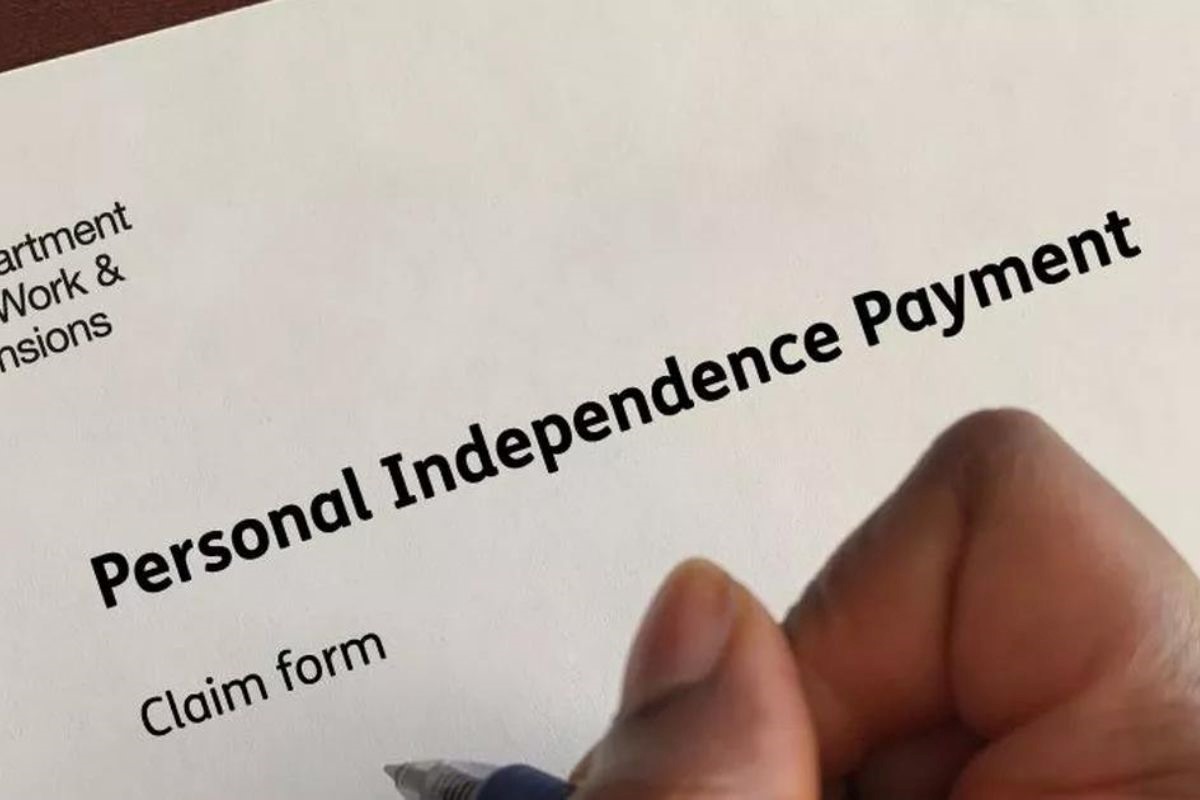
At INFACT, our mission is simple but powerful: to stand alongside and support children, young people, adults, and families living with Fetal Valproate Spectrum Disorder (FVSD). As the UK’s leading national charity for FVSD, we understand the daily challenges families face and the barriers they often encounter when accessing Personal Independence Payment (PIP) and other support.
Many parents and carers tell us that securing PIP for their child or adult family member with FVSD can be stressful and overwhelming. PIP is designed to help disabled people manage the extra challenges and costs of daily living. Yet families often struggle to communicate the full impact of FVSD, despite it being a government-recognised lifelong disability and recognised by the NHS England , MHRA and World Health Organization.
Why We Created PIP Support Resources
FVSD affects nearly every aspect of daily life. From learning, memory, and communication, to mobility, mental health, and independence. Individuals with FVSD often require ongoing supervision, prompting, and support to safely manage everyday tasks. Without financial assistance, families face additional costs for care, therapies, transport, and essential daily living needs.
To address this, INFACT has developed official supporting letters and factsheets for families to attach to their PIP applications. These resources clearly explain how FVSD meets PIP criteria and provide families with the authority and credibility of a national charity supporting FVSD.
How INFACT Supports Families
As the UK’s leading charity for FVSD, INFACT has been at the forefront of raising awareness, campaigning for recognition, and working with government, healthcare professionals, and organisations such as the World Health Organization. Our support is practical as well as advocacy-driven:
We provide PIP guidance and supporting letters for families affected by FVSD.
We offer information on daily living support, therapies, and care options.
We connect families with a community of parents, carers, and individuals who truly understand the challenges of living with FVSD.
Ensuring Families Get the Support They Deserve
Our goal is to make sure families are not left navigating the benefits system alone. The INFACT PIP Support Pack helps families demonstrate the full impact of FVSD on mobility and daily living, giving them the best chance of securing the support they need.
We are here to ensure that every person affected by FVSD can access the care, resources, and financial assistance they require to live as safely and independently as possible.
Can I Use INFACT’s PIP Support Resources if My Child Hasn’t Been Diagnosed with FVSD?
Yes – and we strongly encourage you to do so.
At INFACT, we believe that any child exposed to sodium valproate during pregnancy should be considered at risk of Fetal Valproate Spectrum Disorder (FVSD), even if a formal diagnosis has not yet been made. This view is supported by the UK Medicines and Healthcare products Regulatory Agency (MHRA) and by leading clinical guidance.
Many children affected by valproate exposure may show subtle or evolving symptoms, such as learning difficulties, developmental delays, or sensory sensitivities, which can make diagnosis challenging. A lack of formal diagnosis does not mean that a child does not experience the day-to-day difficulties that FVSD causes.
For the purposes of Personal Independence Payment (PIP):
The focus is on how your child’s condition affects their daily living and mobility, not solely on the presence of a formal label.
Families can use our support letters and factsheets to clearly explain the impact of valproate exposure, highlighting practical examples of assistance, supervision, or adaptations that your child requires.
Including information from a recognised charity like INFACT adds credibility and supports your evidence, regardless of formal diagnosis.
In short: If your child was exposed to valproate in utero and experiences challenges in learning, mobility, personal care, or daily functioning, you should use our PIP support resources. They are designed to help you explain the real-life impact of FVSD and secure the support your child needs.
At INFACT, we continue to fight for recognition, justice, and support for families living with FVSD : because no family should have to face these challenges alone.
It’s been another incredibly busy year for the INFACT Campaign during Labour’s first Parliament in Government. Since the election, we’ve made 10 separate visits to Westminster, and reached out to every single new MP.
One of our first major actions of the year was a powerful trip to 10 Downing Street, where we hand-delivered a petition letter, joined by Baroness Cumberlege and Dr Peter Turnpenny and affected families. This marked a significant moment in our campaign, showing unity and continued pressure at the very highest level.
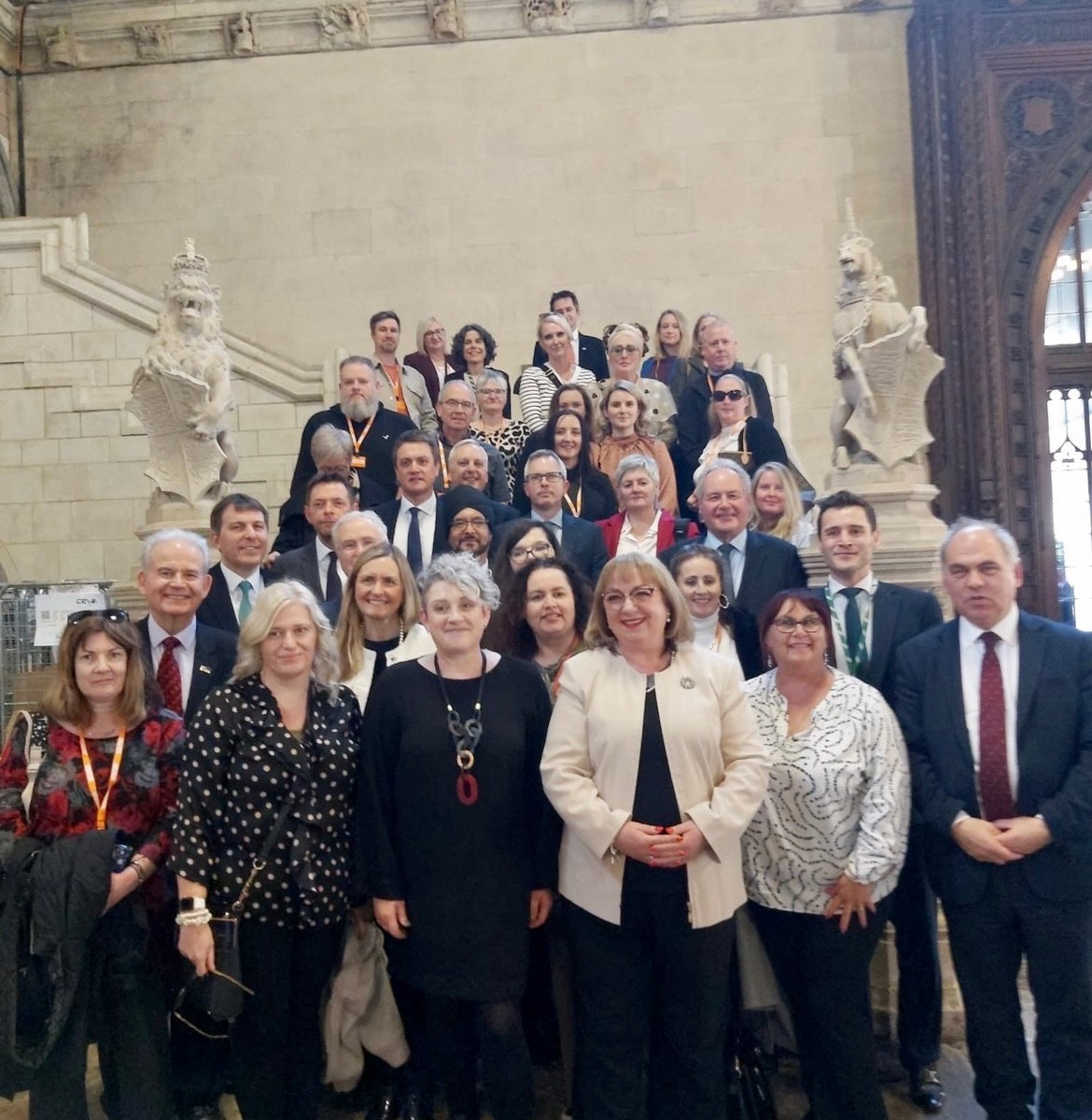
It was also a real privilege later that month to be invited to Baroness Cumberlege’s retirement function at the House of Lords, a special opportunity to thank her for her tireless commitment to patient safety and justice.
As many of you will know, it’s been challenging to secure meetings in these early months of the new parliamentary term, even with the amazing efforts from so many of you contacting your local MPs directly. Please know, your voices absolutely matter, and we are so grateful for your continued support.
Despite the challenges, we’ve achieved a great deal:
Over 100 written parliamentary questions have been submitted and answered.
John Glen MP raised the need for Parliamentary Time to discuss the recommendations of the Hughes Report during Business Questions.
Sharon Hodgson MP successfully secured a Westminster Hall Debate, where the Government issued a formal apology.
We’ve had constructive meetings with both long-standing and newly elected MPs, many of whom are now actively working alongside us.
One of the real highlights of the year came later on, when we were invited to deliver an educational talk and presentation to the new staff team of the FEMS (Fetal Exposure to Medicines Service) at Manchester Children’s Hospital. Being able to inform and equip frontline professionals with our lived experience and knowledge is a huge step forward in improving care for families impacted by FVSD and FACS.
On the media front, it’s been a powerful year:
The News Agents Podcast created a huge impact.
Families bravely shared their stories on Woman’s Hour and regional and national TV.
We continued to receive vital backing from ITV, Shaun Lintern, and The Sunday Times.
Amazingly we were also nominated for A Pride of Britain Special Recognition Award.- we eagerly await to see the outcome of that.
As Parliament now breaks for the summer recess, our team is already busy preparing for September. We’ve got major national media coverage lined up and are working on several new projects to keep the spotlight on this campaign.
If the page seems a little quieter over summer, please know : we haven’t gone anywhere. Any urgent updates will be shared promptly. And as always:
The INFACT National Helpline remains open on 01253-799161
The online support group continues to be a safe and supportive space 24/7.
Our revamped website and social media platforms have also gone from strength to strength. Engagement and membership have grown significantly, and we are reaching more families, professionals, and supporters than ever before. Our community continues to expand, and we’re so proud of the connections being made every day.
And finally, while we’ve not yet received an official Government response on compensation, we want to be clear: we are confident in our position and we WILL win this campaign. We have proven liability, causation, and regulatory failure, supported by two Government-backed reports. Justice is not a matter of if ……it is a matter of when.
Thank you for standing with us, we are here with you, every step of the way.


 Donate here: https://infactuk.com/donate/ INFACT

 Key Legal Differences: Funding & Responsibility
 France
 United Kingdom
 The UK’s Only Remaining Route, Parliament:
 A Fight Against the Establishment:
 Our Blueprint for Success:




 INFACT