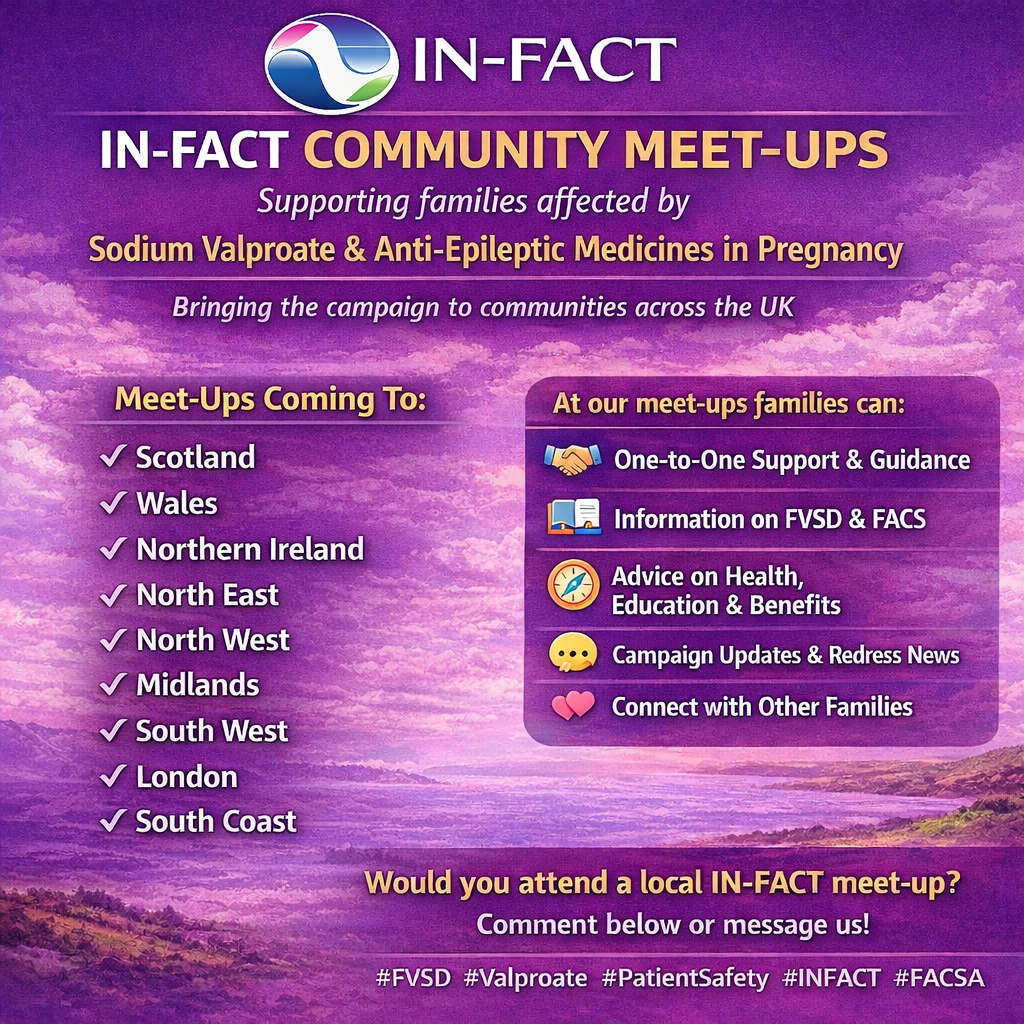
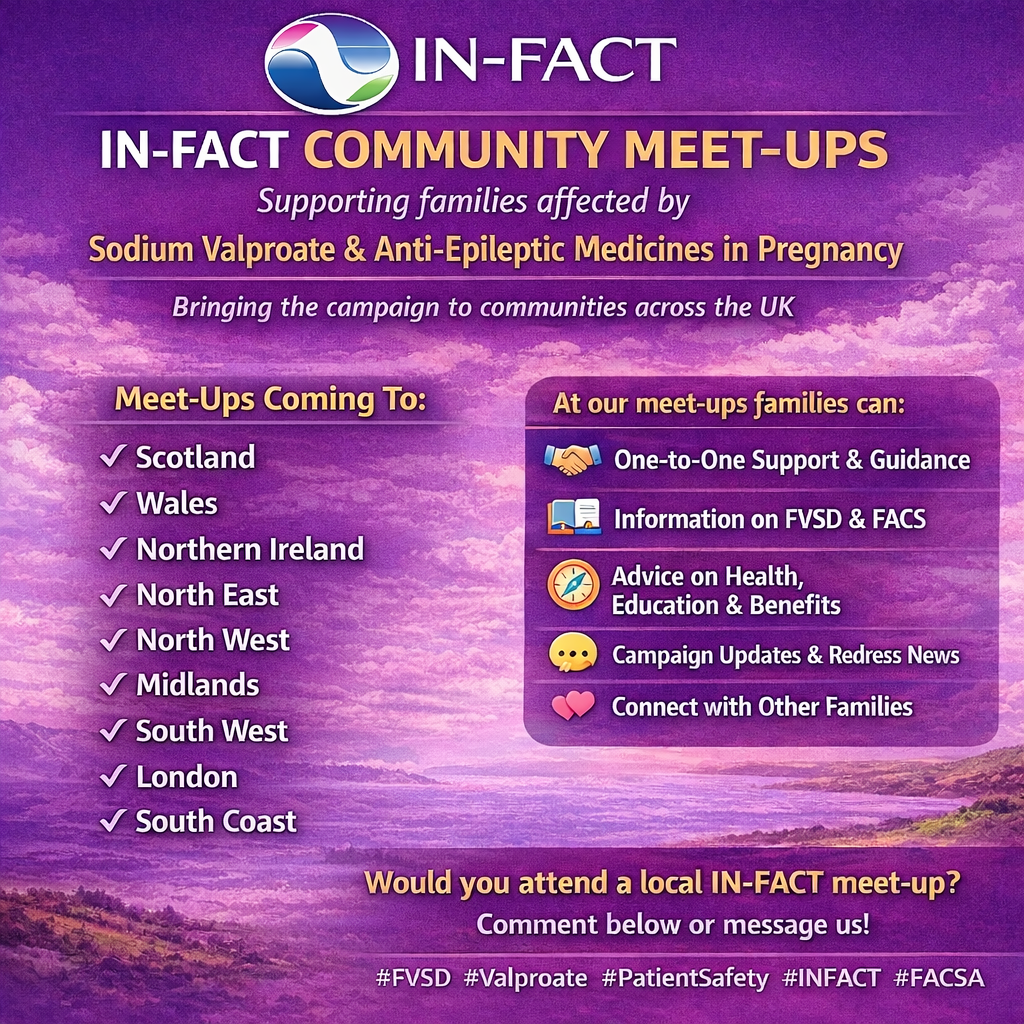
INFACT (The Independent Fetal Anti-Convulsant Trust) is pleased to announce that we will soon be launching a series of community meet-ups across the UK for families affected by Sodium Valproate and other anti-epileptic medicines taken during pregnancy.
For many years families from across the UK have contacted INFACT seeking support, information, and guidance following a diagnosis of Fetal Valproate Spectrum Disorder (FVSD) or other Fetal Anti-Convulsant Syndromes (FACS).
While we regularly support families through our online community, email and telephone support, we recognise how important it can be for families to meet in person, share experiences, and connect with others who understand the challenges they face.
These community events will allow us to bring the campaign directly into local communities, giving families the opportunity to meet the INFACT team face to face in a welcoming and supportive environment.
What Families Can Expect
Our community meet-ups will provide an opportunity for families to:
• Receive one-to-one support and guidance from the INFACT team • Access information about Fetal Valproate Spectrum Disorder (FVSD) and Fetal Anti-Convulsant Syndromes (FACS) • Get advice on healthcare, education and benefits support • Hear updates on the national campaign and progress around recognition and redress • Connect with other families who share similar experiences
Living with the impact of these medicines can be incredibly challenging for both children and adults affected, and many families describe feeling isolated or unsure where to turn for trusted information and support.
Our aim is to create safe and supportive spaces where families feel listened to, understood, and connected to a wider community.
Help Us Plan the Locations
We are currently planning around six community meet-ups across the UK.
In order to organise these events and ensure they are held in locations that are accessible to as many families as possible, we would like to hear from those who may be interested in attending.
If you would like to attend a future meet-up, please contact us and let us know your approximate location. This will help us determine the most suitable areas for hosting these events.
Bringing the Community Together
For many years INFACT has worked alongside families, healthcare professionals, policymakers and parliamentarians to raise awareness of the risks associated with Sodium Valproate in pregnancy and to advocate for better recognition and support for those affected.
These community meet-ups represent an important step in strengthening support networks for families and ensuring that lived experience continues to shape the work we do.
Further information about locations and dates will be shared soon.
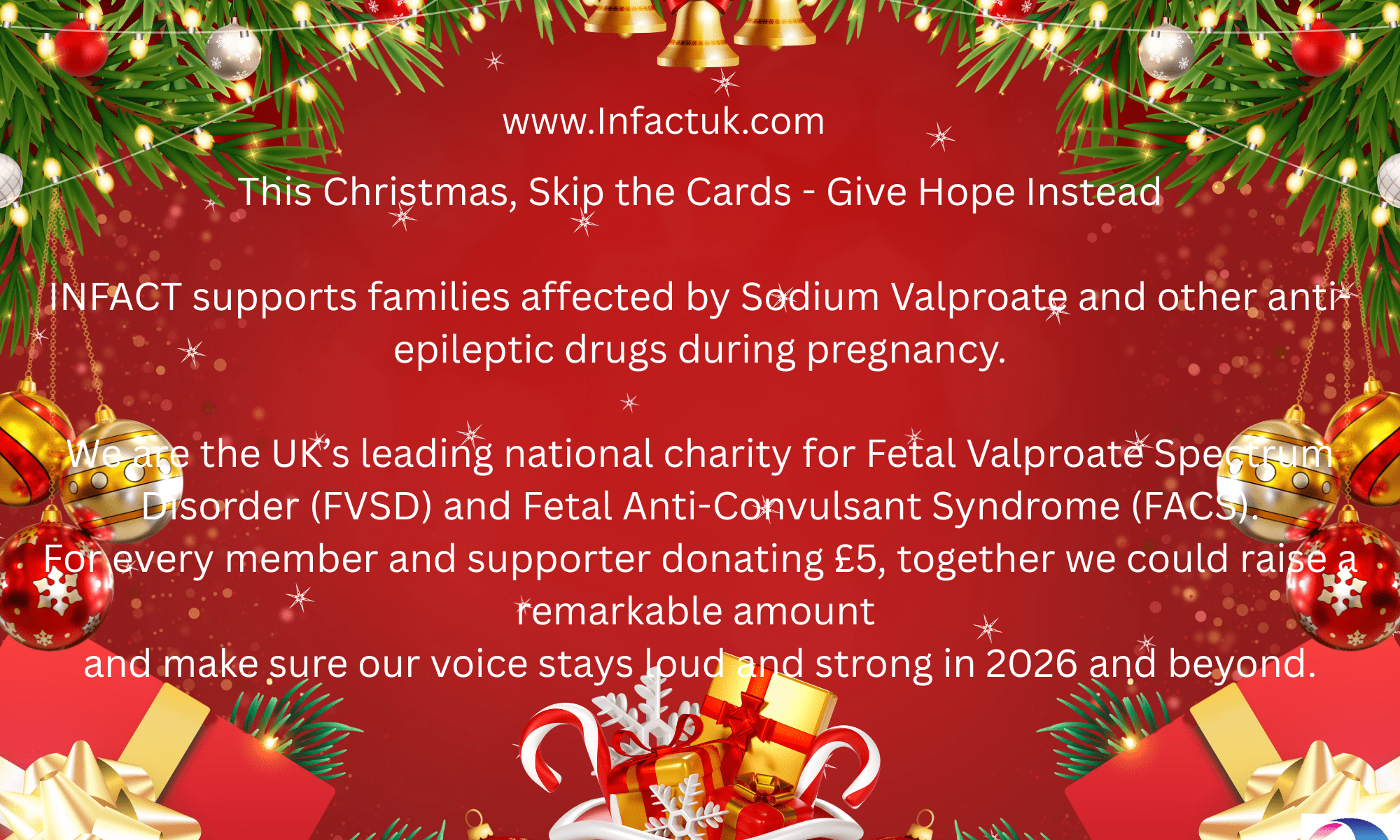
More and more people are choosing not to send Christmas cards, and instead donate what they would have spent to causes close to their hearts.
This year, if you’re thinking about doing the same, We’d love for you to consider supporting INFACT.
INFACT exists to support families whose lives have been changed forever by exposure to Sodium Valproate and other anti-epileptic drugs during pregnancy. We are the UK’s leading national charity for Fetal Valproate Spectrum Disorder (FVSD) and Fetal Anti-Convulsant Syndrome (FACS) – a lifelong disability that affects thousands of children and their families.
We do this because no family should face this alone – yet with no government and pharmaceutical funding and a non profit organisation, every penny we receive matters.
Your donation helps us to: • Provide free educational resources, practical support, and guidance for parents, carers, and professionals. • Run vital awareness and national campaigns to keep FVSD and FACS on the political agenda. • Lobby government, regulators, and MPs to push for justice, recognition, and better protections for affected families. • Cover essential costs that keep our helpline, website, resources, and community going strong.
If each member and supporter donated just £5, together we could raise a remarkable amount – and make sure our voice stays loud and strong in 2026 and beyond.
This Christmas, let’s turn the love we share into real support and real change for families who need it most.
We know how painful and unfair it feels to watch families in France receive compensation for the harm caused by Valproate (Epilim), while families here in the UK continue to be denied justice. The difference isn’t the harm, because the harm is the same devastating harm in both countries and around the world.
The difference lies in the legal systems and political decisions made in each nation.
Key Legal Differences: Funding & Responsibility
France
What happened:
Families successfully brought a class action against Sanofi (the manufacturer) and the French medicines regulator(ANSM).
Outcome:
The courts found both Sanofi and the State responsible for failing to warn women.
As a result, in 2017 the French Parliament created a National No-Fault Compensation Fund (ONIAM).
United Kingdom
What happened:
Legal Aid for the UK class action (known as the FAC Litigation) was withdrawn in 2012, shutting down the only legal route that could have forced Sanofi to compensate families.
Outcome:
Without Legal Aid, families were left with no viable way to pursue litigation against the manufacturer. Bottom line:
France won its case in court.
The UK case was stopped, not because of weak evidence, but because Legal Aid was pulled.
The UK’s Only Remaining Route, Parliament:
Because the legal case against Sanofi was shut down, the only path left is to hold the UK Government to account for its failures.
This is known as the Parliamentary Route, the strategy INFACT is currently pursuing, on firm legal advice.
Why Litigation Is No Longer Possible in the UK?
To avoid confusion:
No new legal action can be taken against Sanofi in the UK.
Even families who were not part of the original litigation cannot start a new claim because:
The UK spent £3.2 million in public funds preparing the class action
When Legal Aid was withdrawn, the case collapsed.
Financially, it is impossible to privately fund a lawsuit of this size.
Legally, the precedent and procedural history block future claims.
Why was Legal Aid really withdrawn?
The Legal Services Commission withdrew Legal Aid from the case as it was deemed by them that the case was not sufficiently likely to succeed in court against the manufacturer, Sanofi. The decision to withdraw legal aid was appealed by the claimants, but the appeal was rejected by an independent panel of lawyers.
Documents uncovered later by INFACT indicate that the evidence gathered would likely have shown:
Sanofi warned the UK Government about serious risks, even though Sanofi failed to issue stronger public warnings in the 1980s.
The Government then chose deliberately not to warn women, despite knowing the risks.
This dual responsibility, manufacturer and State, may have been politically explosive, and withdrawing public funding halted the case before those findings could reach court. This is why the Parliamentary Route is now the only viable pathway to compensation.
Moral vs Legal Responsibility:
It’s important for families to understand a key distinction: Morally, Sanofi is responsible.
It is their medicine, and they failed for decades to provide adequate, timely, and prominent warnings about the risks to unborn babies. Families across the UK, France, and globally were harmed because the manufacturer did not act with the urgency or transparency that was needed.
Legally, however, responsibility in the UK sits with the MHRA and the wider Establishment.
The British regulatory system, the MHRA, Government departments, advisory committees, and health authorities, were the ones who chose what information was shared with women. They received warnings, yet suppressed them.
Because of this, the legal system views the failure as one of State regulation, not manufacturer liability.
This is why the UK cannot pursue Sanofi through the courts, and why the Government must now provide redress.
INFACT’s Breakthrough at the National Archives:
Our investigation at the National Archives was the turning point.
We discovered documents proving that,
as early as 1973, the UK’s Committee on Safety of Medicines knew Valproate carried a high risk of birth defects.
The Government made a deliberate decision to caution doctors but not women taking the medicine.
This evidence which we directly presented to Jeremy Hunt in person when he was Health Minister contributed to the creation of the Independent Medicines and Medical Devices Safety (IMMDS) Review.
A Fight Against the Establishment:
Our campaign sits alongside some of the UK’s hardest-fought justice movements:
The Post Office scandal
Hillsborough
Contaminated Blood
WASPI
These campaigns all share something in common:
They challenge deep systemic failings within the State itself.
This work is slow, exhausting, and often met with resistance, but it can be won through persistence, unity, and truth.
Our Blueprint for Success:
The Cumberlege Review (2020)
The Independent Medicines and Medical Devices Safety Review (IMMDS), chaired by Baroness Julia Cumberlege, found that thousands of families harmed by Valproate experienced avoidable harm caused by systemic failures.
Key outcomes:
Confirmed decades of failure by regulators, the NHS, and Government.
Highlighted that women were repeatedly dismissed, ignored, or misinformed.
Recommended the creation of an independent Redress Agency and a Government-funded compensation scheme.
The Government offered a “fulsome apology” but rejected the recommendation to introduce compensation.
What Happened Next: INFACT at the Health Select Committee (December 13th, 2022)
Following the Government’s refusal to implement the Cumberlege Review’s recommendation for a compensation agency, INFACT were called to give evidence at the Health and Social Care Select Committee.
On 13th December 2022, we presented the full scale of the Valproate scandal, exposing the decades of Government failures, regulatory neglect, and the human cost carried by families.
Our evidence, delivered directly to MPs, made it impossible for the failings to be ignored any longer. This moment was critical. It was our testimony that pushed the Government to acknowledge the unresolved injustice and ultimately led to the commissioning of the next major report: The Hughes Review.
The Hughes Report (2024) commissioned in the wake of INFACT’s Select Committee evidence, was tasked specifically with examining compensation options for families harmed by Valproate.
Key outcomes:
Recognises the lifelong, devastating harm endured by affected families.
Affirms the urgent need for a Government compensation scheme.
Proposes a realistic, two-stage redress model that could be implemented without delay.
Why Your Voice Matters
In France, families won justice through the courts.
In the UK, our route to justice is through Parliament, and that means your voice is essential.
Every message you send, every story you share, every email to your MP builds the pressure that forces Westminster to act. MP support is absolutely critical. Without MPs raising this in Parliament, the Government can continue to delay, minimise, or ignore the issue.
We need families to keep writing to MPs, meeting with them, sharing your experiences, and asking them to stand with the campaign. The more MPs who speak up, the harder it becomes for the Government to deny the urgent need for compensation and care.
Your voice drives awareness.
Your MPs carry that voice into the heart of Westminster.
Together, we create the pressure needed for change
The Parliamentary Route remains the only legally viable path to justice, with a united community and committed MPs behind us, we will get there.
With the Cumberlege Review and the Hughes Report behind us, along with support from MPs and Peers and the continued support from The Sunday Times and media outlets the evidence is now overwhelming. The Government can no longer deny what happened, or delay addressing it.
At INFACT, our mission is simple but powerful: to stand alongside and support children, young people, adults, and families living with Fetal Valproate Spectrum Disorder (FVSD). As the UK’s leading national charity for FVSD, we understand the daily challenges families face and the barriers they often encounter when accessing Personal Independence Payment (PIP) and other support.
Many parents and carers tell us that securing PIP for their child or adult family member with FVSD can be stressful and overwhelming. PIP is designed to help disabled people manage the extra challenges and costs of daily living. Yet families often struggle to communicate the full impact of FVSD, despite it being a government-recognised lifelong disability and recognised by the NHS England , MHRA and World Health Organization.
Why We Created PIP Support Resources
FVSD affects nearly every aspect of daily life. From learning, memory, and communication, to mobility, mental health, and independence. Individuals with FVSD often require ongoing supervision, prompting, and support to safely manage everyday tasks. Without financial assistance, families face additional costs for care, therapies, transport, and essential daily living needs.
To address this, INFACT has developed official supporting letters and factsheets for families to attach to their PIP applications. These resources clearly explain how FVSD meets PIP criteria and provide families with the authority and credibility of a national charity supporting FVSD.
How INFACT Supports Families
As the UK’s leading charity for FVSD, INFACT has been at the forefront of raising awareness, campaigning for recognition, and working with government, healthcare professionals, and organisations such as the World Health Organization. Our support is practical as well as advocacy-driven:
We provide PIP guidance and supporting letters for families affected by FVSD.
We offer information on daily living support, therapies, and care options.
We connect families with a community of parents, carers, and individuals who truly understand the challenges of living with FVSD.
Ensuring Families Get the Support They Deserve
Our goal is to make sure families are not left navigating the benefits system alone. The INFACT PIP Support Pack helps families demonstrate the full impact of FVSD on mobility and daily living, giving them the best chance of securing the support they need.
We are here to ensure that every person affected by FVSD can access the care, resources, and financial assistance they require to live as safely and independently as possible.
Can I Use INFACT’s PIP Support Resources if My Child Hasn’t Been Diagnosed with FVSD?
Yes – and we strongly encourage you to do so.
At INFACT, we believe that any child exposed to sodium valproate during pregnancy should be considered at risk of Fetal Valproate Spectrum Disorder (FVSD), even if a formal diagnosis has not yet been made. This view is supported by the UK Medicines and Healthcare products Regulatory Agency (MHRA) and by leading clinical guidance.
Many children affected by valproate exposure may show subtle or evolving symptoms, such as learning difficulties, developmental delays, or sensory sensitivities, which can make diagnosis challenging. A lack of formal diagnosis does not mean that a child does not experience the day-to-day difficulties that FVSD causes.
For the purposes of Personal Independence Payment (PIP):
The focus is on how your child’s condition affects their daily living and mobility, not solely on the presence of a formal label.
Families can use our support letters and factsheets to clearly explain the impact of valproate exposure, highlighting practical examples of assistance, supervision, or adaptations that your child requires.
Including information from a recognised charity like INFACT adds credibility and supports your evidence, regardless of formal diagnosis.
In short: If your child was exposed to valproate in utero and experiences challenges in learning, mobility, personal care, or daily functioning, you should use our PIP support resources. They are designed to help you explain the real-life impact of FVSD and secure the support your child needs.
At INFACT, we continue to fight for recognition, justice, and support for families living with FVSD : because no family should have to face these challenges alone.


 Key Legal Differences: Funding & Responsibility
 France
 United Kingdom
 The UK’s Only Remaining Route, Parliament:
 A Fight Against the Establishment:
 Our Blueprint for Success: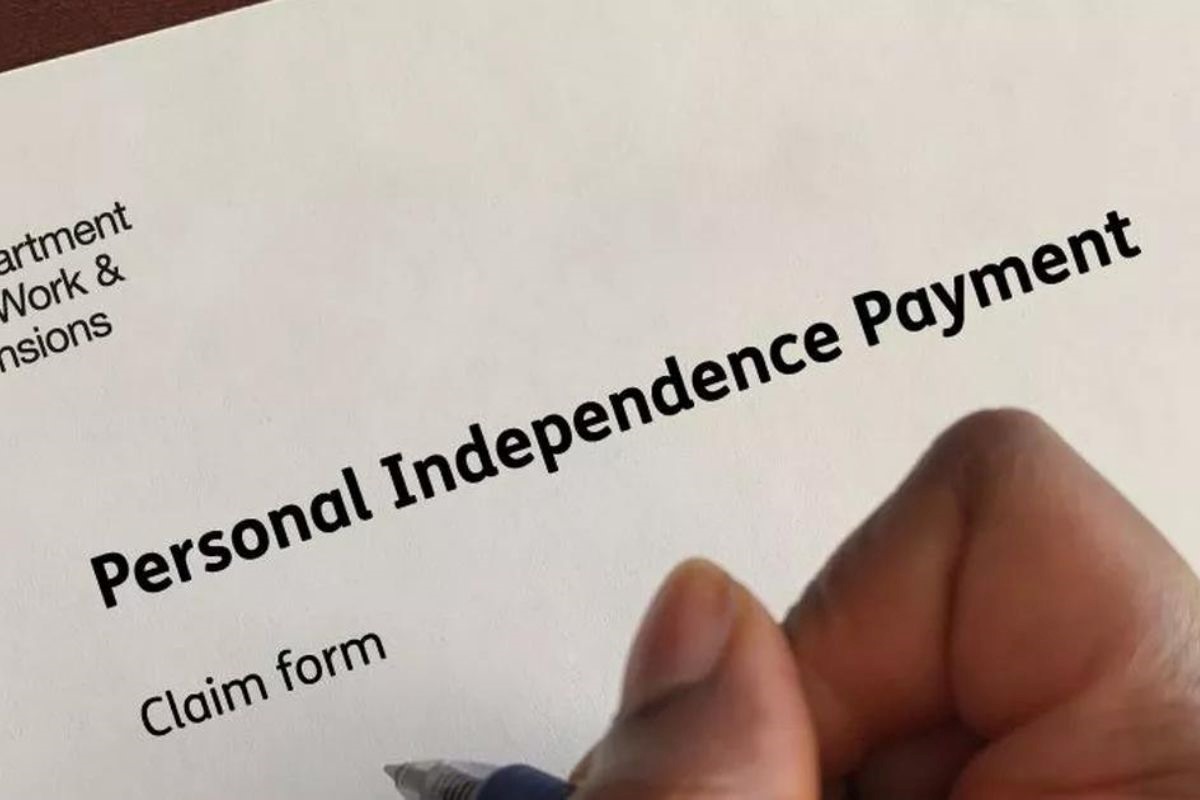
 INFACT